How Should Women Over 43 Plan for Pregnancy?
For later-age fertility care, the real race is against time: retrieve eggs as soon as it is reasonable, instead of spending months on “egg nourishing.” If you are over 43 and trying to conceive—especially if IVF is on the table—use the remaining window, don’t burn it on a long preparatory regimen. Get AMH, antral follicle count, and sex-hormone tests promptly. When those baselines are adequate, assisted reproduction can start. If ovarian reserve and AMH are already low, the priority is retrieval and usable embryos; transfer can wait (freeze first, then timed frozen-embryo transfer).
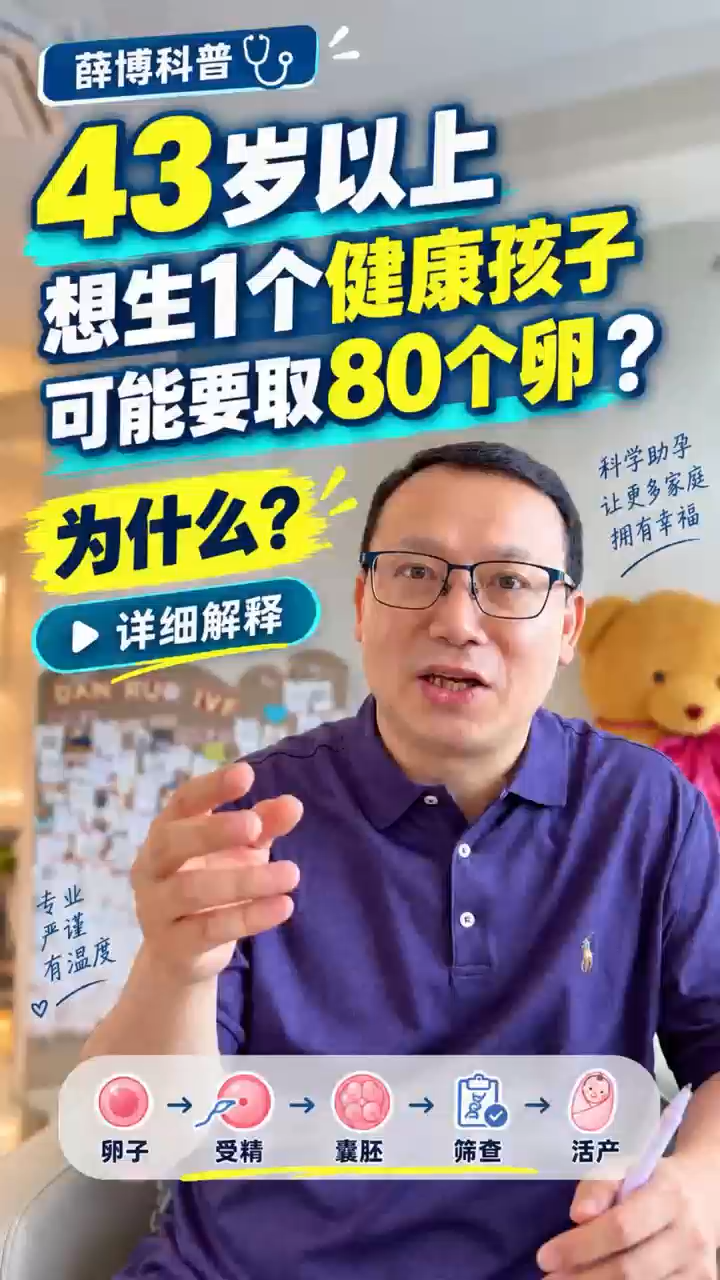
For later-age fertility care, the real race is against time: retrieve eggs as soon as it is reasonable, instead of spending months on “egg nourishing.” If you are over 43 and trying to conceive—especially if IVF is on the table—use the remaining window, don’t burn it on a long preparatory regimen. Get AMH, antral follicle count, and sex-hormone tests promptly. When those baselines are adequate, assisted reproduction can start. If ovarian reserve and AMH are already low, the priority is retrieval and usable embryos; transfer can wait (freeze first, then timed frozen-embryo transfer). When eggs are scarce and you do not need sex selection, be cautious with PGT; keeping usable embryos comes first. A routine male workup is usually enough—don’t pour energy into chasing sperm numbers again and again. Severe oligoasthenoteratozoospermia still needs an andrologist, but the bottleneck is typically the ovaries. Any plan has to be based on your tests and an in-person visit at a licensed fertility centre.
1. Trying to conceive at 43: what to get straight first
Many people over 43 fall into the same trap: they want to “tune up” for months, wait until the ovaries look better, and bank more eggs before they start. Biologically, age is the first variable in a fertility plan. Time is the scarce resource, and it does not come back.
After 42, the chance of chromosomal errors (aneuploidy) in eggs rises sharply, and the odds of natural conception and a live birth fall. That curve is not reversed by Chinese medicine, food supplements, or a long course of conditioning.
One point is easy to miss: don’t spend a long stretch treating issues that are not the main constraint. Half a year or a year of “nourishing the body” can look productive and still consume the last usable window. Over 43, the first rule is to get assessed quickly and use the best eggs you have now—not to wait for a future cycle that might yield more. If you are considering IVF, assess first, then decide on a cycle; don’t start with months of egg nourishing.
Couples also tend to over-focus on the male semen report—repeat tests, repeat “sperm improvement.” In most cases, from the twenties into the fifties, semen parameters have a limited effect on live-birth rates. You don’t need to obsess over morphology, DNA fragmentation, or concentration. Serious oligoasthenoteratozoospermia still belongs with an andrologist. The centre of gravity remains the woman’s ovarian reserve.
2. IVF at a later age: why retrieval and transfer are often split
When reserve is low and age is over 43, egg retrieval can come first. Embryos can be frozen. There is no need to rush a transfer.
Many patients in this group get only one or two eggs per retrieval, with a low AMH. If there is no need for sex selection, PGT is not automatically required.
PGT cuts both ways. It can raise the chance of success per transfer and spare you futile transfers, but it also lowers how many embryos remain usable. When eggs are already few, embryo yield is the scarce asset. If you have few embryos, bank them, freeze what you have, and transfer in later FET cycles. Don’t let screening discard embryos you may not be able to replace.
In difficult cases, if a non-progestin stimulation protocol is used and both embryo and lining look good, a fresh transfer is still an option—not the default strategy.
3. IVF or trying to conceive at 43: five practical steps
- Complete an ovarian workup promptly: AMH, antral follicle count, and sex hormones. Map current reserve. Don’t delay.
- Shorten long pre-treatment cycles. If baseline health is adequate, start. Don’t default to months of egg nourishing.
- Retrieve first, freeze, and bank. Split retrievals to accumulate embryos; postpone transfer so each retrieval is used. Fresh transfer is sometimes reasonable; it is not the main path.
- Use PGT with judgment. When eggs are few, be cautious; keep the embryos you already have.
- Divide the work: her ovaries and eggs are the core; a routine male check is usually enough. Don’t over-read morphology or fragmentation.
4. Risks of later-age IVF, and where this article stops
Pregnancy and IVF at a later age carry higher risks of miscarriage, chromosomal abnormality, and obstetric complications. Plans must follow your own results, under a physician at a licensed fertility centre. This article is general information for people trying to conceive. It is not a substitute for an in-person medical opinion.
Need a Personalized Plan?
Book a consultation with your records—advisors and specialists will assess your pathway.
Book Consultation